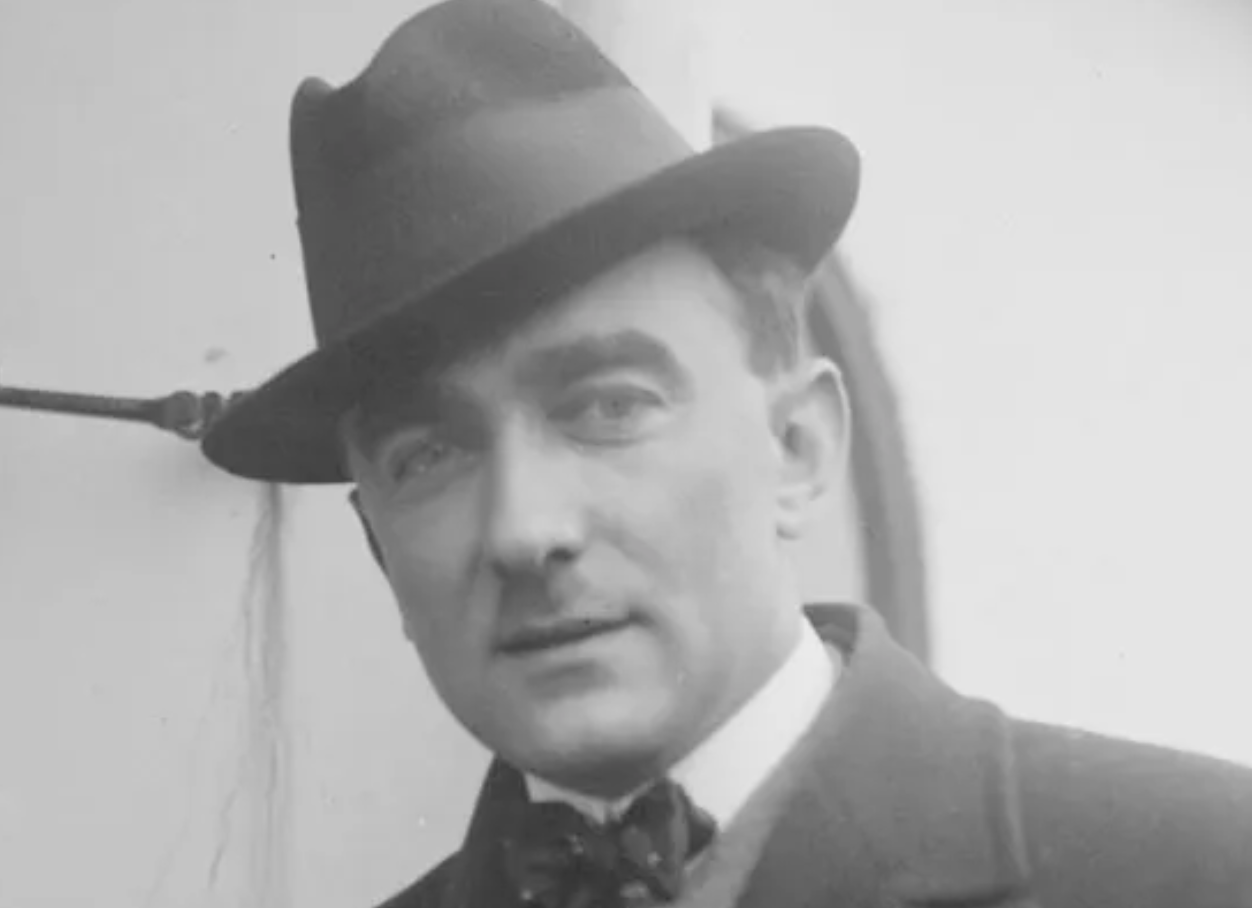
Szymanowski’s Stabat Mater was commissioned by the Warsaw patron of the arts, Dr Bronislaw Krystall, and was meant as a Requiem dedicated to the memory of his prematurely deceased wife. However, after the sudden and tragic accidental death of Szymanowski’s young niece, Alusia Bartoszewiczówna, and having spent much time consoling his (then pregnant) sister, he chose to change the piece to a Stabat Mater as the theme of the suffering and grief of the Mother was so close to his heart at this time. The work was completed a century ago in 1926 and in honour of his contract was dedicated “To the memory of Izabela Krystallowa”. 100 years on, we will be performing this piece on the 7th February 2026 alongside other works by Kaprálová and Bartók.
 Stabat Mater, Latin for ‘the mother was standing’, is the title of a medieval hymn about the suffering of the Virgin Mary at the foot of the cross. Mary has of course been adopted by Polish Catholics and is often referred to by them as ‘Mary, Queen of Poland’ and so was the perfect inspiration and focus for this beautiful piece. The composition intertwines various motifs from Szymanoswki’s work and presents explorations of a spiritual nature. He finds here his own religious modus operandi and doesn’t use the classical Latin text of the Stabat Mater, but instead a Polish translation, an intentionally ‘primitive’ translation: Jankowski’s Polish translation ‘Stała matka bolejąca’. Music critics consider his Stabat Mater one of the most valuable creations bequeathed to music by Szymanowski.
Karol Maciej Szymanowski (October 6, 1882 – March 29, 1937) was born into a wealthy Polish family in Tymoszówka, a village which was then part of the Russian Empire, but is now in Ukraine. He studied at the State Conservatory in Warsaw and became the director there in the same year that he composed the Stabat Mater. He was a key part of the modernist “Young Poland” movement and moved through many themes and styles throughout his life and received many top national awards and honours from Poland and other countries.
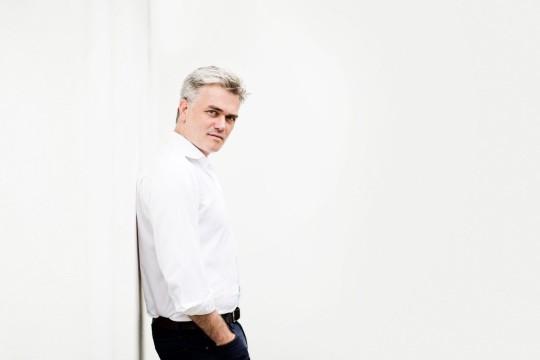
London Philharmonic Orchestra Principal Conductor Edward Gardner, and our conductor for this concert, loves Szymanowski’s music and especially his Stabat Mater:
“I’ve conducted lots of Szymanowski as I adore his music – it has a voluptuousness and an exoticism which is kind of unique but you can tell it’s Polish and Central European. He manages to distill what is often a dense texture in his writing into an almost Mozartian purity in the Stabat Mater whilst never comprising what the essential flavour of his music is – it’s a real sweet spot for him and Polish music in general. It seems to be a kind of meeting point of lots of things; it has that homeland folk element which is so evocative but it also has a deep connection to religion, which is still central to Poland, the doubt and fear and ecstasy. You feel that when Szymanowski writes a religious piece – which he did rarely – it’s incredibly heartfelt, it’s about how the Polish community react to what religion is and its deep sense of Catholicism.
The Stabat Mater is one of my favourite pieces, it’s like a little jewel. Normally with Szymanowksi you’re battling the balance and working to spotlight whatever is important in the score because he writes with such fervour and density usually – but in this piece, as soon as the first note is played on the flute you know where you are with it, like Britten in a way but more incensed in the sound. It’s just a masterpiece and his bravery to be simple in it is unlike anything else he wrote.
The choir plays different roles in the piece and the female voices are used much more than the male voices. The female voices are often an angelic accompaniment to the soprano, which is how the piece opens. Central to it is the unaccompanied choir moment, movement 4, which is breathtakingly simple and beautiful – you get this purity of the choir’s sound which is so special. To me it really is one of the greatest things he wrote, it’s so folk inflected – almost like a Christmas carol at times, in a way it’s a mini version of the Glagolitic Mass, where the choir represent a normal group of people on their best behaviour for a Sunday morning mass, but Szymanowki is a bit more reverential in his writing than Janáček was.
This piece is a deeply expressive work and a unique voice within 20th-century sacred music, a piece that will touch everyone who hears it.”
LPC tenor and voice rep Mikolaj Walczak has been helping our chorus director Madeleine Venner with research on the text of the Stabat Mater, and also coached us in Polish for our first rehearsal of the piece.
 “I’ve heard the piece quite a few times in Poland and I’m definitely looking forward to singing it here. I find it really exciting that we’re doing something in Polish and am very happy to help the choir with this. I went through the whole piece in terms of lyrics with Madeleine because although Szymanowski included the Latin text it’s not a direct translation of the Polish text.
The Polish text is much more personal so we prepared a direct translation word for word, rather than a nice poetic one, so at least we know what we are saying and what we are singing about which is really important. It was actually interesting as it’s quite archaic language, even in Polish, so I didn’t know how to translate it in the first place and I had to call my aunty, luckily she helped. The words mean quite different things in modern Polish than the old Polish so what we’re singing now is direct from the old Polish: Szymanowski stated in his score that the Stabat Mater should always be sung in Polish.
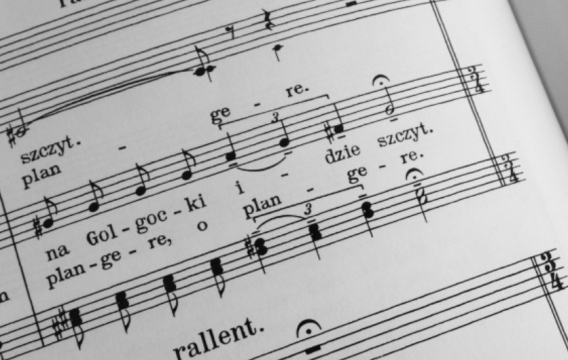
Teaching the choir to sing the correct sounds is quite interesting for me as some of the Polish sounds are totally different to English ones and are difficult to get right, for example words such as ‘szczyt’ (meaning height or pinnacle) which you would never see in English. Then there are sounds such as the English ‘sh’ for example – the ‘sh’ sound is between the Polish ‘si’ and ‘sz’ but how do you explain that or get the ‘English ear’ to hear it? That’s what you have to do as a language coach as well as explain the meaning of the words and it’s really important because you might hear ‘sh’ but the Polish has two completely different meanings – for example ‘Proszę’ means please but ‘Prosię’ means piglet! Given that we are singing about the suffering of Mary we can’t get sounds mixed up so you can imagine I was quite worried before the first rehearsal but I was very impressed how the Polish was coming through even after one rehearsal. Obviously there are still things that can be improved but luckily we have a professional coach now so I can just focus on singing.
I’m particularly excited to sing in this concert not only because it’s quite rare to sing a piece in Polish outside of Poland but also because my aunty – who helped with the translation – is flying over to hear us so this is going to be a really extra special performance for me.”
Alto (Dr) Muriel Swijghuisen Reigersberg, who joined the Choir in 2000, is also liaison for the alto section and is Head of Research and Knowledge Exchange at Westminster University in her day job, where she is an expert in music, health, wellbeing, and open access. She has lived and studied around the world although technically she is Dutch!
 “One of the many things I love about singing in the LPC is that we get to perform such exciting and diverse repertoire – which is something I’ve always valued – and we often have a native speaker in the choir for the pieces we are learning, in this case Miko, which also shows the diversity of the choir and the great community we have in London which is really lovely.
I remember first singing Szymanowsky’s Stabat Mater with the choir in 2012, which seems a very long time ago now, and having to learn to sing in Polish. At that time I had a French boyfriend who lived in Paris and we used to travel backwards and forwards on Eurostar to see each other. His mother was Polish/French and didn’t speak English; she also wasn’t too keen on me or my lack of French so I wondered what I could do to try and help our relationship. I then had a brainwave and asked her to try and help me learn this piece which we were singing in Polish, and which she agreed to do. We spent quite a lot of time and she was able to explain the Polish so I could understand the words and she tutored me carefully so I knew how to say them. She was quite exacting but it worked well and our relationship improved, as did my Polish – sadly the one with my boyfriend did not, but that’s another story…
My relationship with the LPC however has grown and flourished – despite having a short hiatus while I popped over to work in Australia in 2016 which meant that I missed the opportunity to use my newly learned Polish in a concert with Vladimir Jurowski. But here we are another decade on, for the centenary of this lovely piece, and I’m singing it again, this time with Edward Gardner. I have to confess I can’t remember all the correct sounds for the words I learned with my ‘tutor’ in Paris, so it’s good to be learning again with the great language coaches we have to help us, as well as using the good written support on our LPC online platform.
This piece is quite powerful emotionally so it’s fomenting something different for me this time. We don’t often get to sing in Polish either (latterly we’ve been singing more in Chinese!) so it’s very nice to do this. It’s a pity the piece is quite short really but it gives you a poignant flavour of the Stabat Mater and it will be very beautiful to sing and to hear, so I’m really looking forward to performing it again.”
Come and hear us
Saturday 7th February 2026
7.30pm, Royal Festival Hall
Edward Gardner conductor
Juliana Grigoryan soprano
Agnieszka Rehlis mezzo-soprano
Kostas Smoriginas bass
London Philharmonic Orchestra
London Philharmonic Choir
Kaprálová Rustic Suite
Szymanowski Stabat Mater
Kaprálová Waving Farewell
Bartók The Wooden Prince