In 804 the Japanese Buddhist priest Kūkai, then aged 30, joined the Japanese ambassadorial delegation of four ships going on a perilous voyage to China as he wished to develop his study in philosophy, poetry, calligraphy, statecraft and Buddhism. He knew to do this he would need to study under the foremost masters of these arts and, at that time, these masters were in China. After less than three years it is said that he had learned what it would take others ten years to achieve, including engineering and science, and he returned to Japan where he became renowned and revered for establishing Shingon esoteric Buddhism and where his influence has remained to this day.
Inspired by the mastery and philosophy of this eighth-century Buddhist monk, the Chinese producer and businessman Yue Yongde, who is behind this concert on the 30th January, decided to make a documentary about Kūkai and commissioned modern classical and film composer Zou Ye to write the music for the documentary. Yue Yongde was so impressed with the music that he decided to commission more of it to help spread the story of Kūkai as widely as possible, which is how the symphony came about.

Written as both a tribute and a meditation, with shifts between moments of luminous stillness and surging grandeur, this exciting, profound and accessible contemporary symphony spreads a message of hope and compassion. This unique concert, which transcends borders, brings together choirs from London and Beijing with a conductor from Japan, who will trace Kūkai’s quest to Tang China and share his philosophies through this music. Blending tribute and meditation, the music reflects the perilous voyage, Kūkai’s spiritual devotion and the enduring message of harmony through which his search for Buddhist wisdom reshaped Japanese thought and culture.
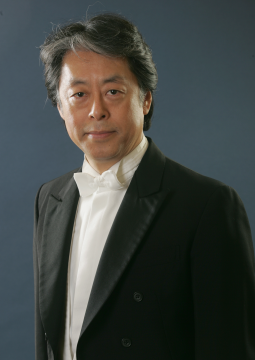 “Yue Yongde’s foundation are supporting and producing our concert,” conductor Takuo Yuasa told us from his home in Osaka, Japan – “and they are behind everything that is making this amazing event happen in London. Mr Yue knows so much about Kūkai and is so impressed by him that he is making it his life’s work to promote his story and philosophies. Like me, he is really looking forward to working with the London Philharmonic Orchestra and London Philharmonic Choir in London, a major international city. I used to work with the LPO in the 90s actually and have great memories of that time. I’m really looking forward to working with the LPC for the first time – I’ve heard that choirs like yours are extremely good and I’m delighted that you will be singing together with the Choir of the Central Conservatory of Music, China, who will be travelling here to be part of this very special performance.
When I was a child I used to live in a house next to a Shingon Buddhist temple and we played in the gardens there so it all became familiar to me. We also used to go to the Koya mountains where Kūkai built his sanctuary, which is still there of course and receives international visitors constantly. Despite its popularity you can really feel the peaceful tranquility; you have a feeling of self awareness and you can purify your mental state by going up there. This is what I think the Symphony is also trying to achieve and is why it’s written to be as accessible to as many people as possible.
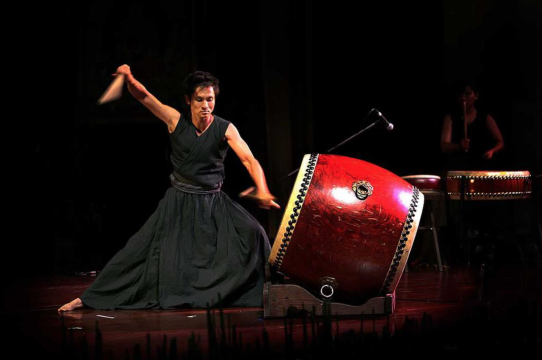
The musical language used is quite conventional in a way even though it is contemporary – it’s very tonal and is very clear but it’s also very powerful and represents the sounds of the temple as well as using the words and mantras of Kūkai. We have special Japanese instruments, so for example when the choir enters four of them will be ringing temple bells and we will also have the traditional Japanese Taiko drum which is used in Japanese festivals and rituals. The score actually says to use a Chinese drum but I wanted it to be what Kūkai would have heard and known. We can also hear the repetition of mantras in the choral parts, as would have been used in prayers and meditations – the choirs are very powerful in this.
I’m reaching a good age now to think about all of this and although the teachings of Kūkai are more than a thousand years old they still make a great sense to me today for myself and also in more universal terms. The biggest teaching of Buddhism is about form and it says that everything is nothing and nothing is everything, rather like the spirit of Zen philosophy. It says that when you realise this then you are again everything. This Kūkai Symphony is sharing these ideas and it’s so relevant for the 21st century; with all that is going on in nature and politics today these teachings make a lot of sense and we can learn from them.”
The mantras of the piece are originally in Sanskrit but the piece itself is in Mandarin which, as you can imagine, is quite a challenge for us to sing (but don’t worry, you’ll have English subtitles). Fortunately we have our wonderful new Guest Associate Chorus Director for 2025/26, Bo Wang, as our language coach so we are getting to grips with what to us is a completely new way of making sounds. Bo is not only Chinese but also a singer and chorus director so he’s a perfect teacher for helping us to sound as authentic as possible in Mandarin Chinese.
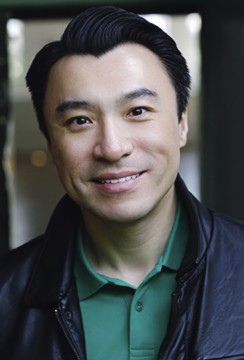 “The English language is so much easier to sing with a tune than Mandarin, it’s much more flowing, so the biggest challenge is for me to make sure that I can train the choir to sing in Mandarin Chinese in a melodic and effective way. I’m aiming to make sure I can deliver the sound and a good basic meaning with some legato. I remember working with the choir two years ago on the Buddha Passion by Tan Dun and it’s clear to see that the LPC members are really prepared for the task this time so my job is not quite as challenging as the first time.
Mandarin is more vowel based than English and we don’t use stresses on words like the English do. We tend to focus on character rather than words and we separate the sounds and speak through vowels so “con-grat-u-la-tions” could be five different words to me. Also, one character can represent a lot more meaning than just one sound so for example “Kū – kai” is “empty” and “ocean”. This is a name given to him by a higher master and that’s why he travelled across the ocean – it was already engraved in him as his name.
In Kūkai Symphony the lyrics are all poems so they’re not everyday spoken language and the meanings are deeper. It’s a great experience for me to teach the choir to sing poems as they’re completely different to our everyday work and are really beautiful, and also they’re taken from Kūkai’s own work. The last movement is my personal favourite because it summarises and reflects Kūkai’s personal journey; it talks about travelling and learning and taking the learning over to the next journey in a religious and artistic way. It also talks about how grateful Kūkai is to all the masters who trained him and about how after his mission/journey was completed he then dedicated himself to all people who made him what he is. I find this inspirational and I really admire him. What he has done is breaking the language barrier across politics and borders – he had such a vision of humanity being ‘one’ which I think is a really important message for us today.
I remember listening to the LPO and LPC on recordings as a child in China and now that I’m working with you and coaching you in my own language I have to pinch myself, it’s like a dream come true! I trained as a singer and have sung in many other languages and what I truly believe in a platform like this is that it’s only the LPC who could be this international. This piece is truly a celebration of the global citizen internationally so it’s really fulfilling for me. I think the LPC is a truly international and global choir.”
Choir manager and alto Natasha Sofla completely agrees with Bo:
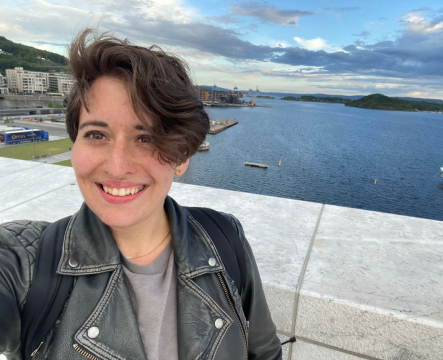 “One of the many things I love about the LPC is that we have so many international singers and that we sing repertoire from a wide global range of music. This piece is the perfect example of that – a Chinese Symphony about a Japanese monk, written by a contemporary Chinese composer and conducted by an international Japanese conductor, in London with a Chinese and a UK choir.
I think the piece itself is really interesting and I’m excited to be singing something new. I’m also enjoying the challenge of having to learn Mandarin which is completely new to me, even though I am a bit of a language nerd. The sounds are so completely different to English sounds and have to be pronounced in a totally different way! I’m fascinated by the story of Kukai too, who I’d never heard of, so it’s great to be learning about him and the Buddhism he was so passionate about and helping to share his story.
I love any opportunity to learn a new piece of music to be honest, particularly a contemporary piece, because I’m a contemporary composer myself which is why I always advocate for new pieces. I did my degree in classical music in Birmingham and then my Masters in Film and TV composition so now I do both – only in my spare time at the moment as it’s quite hard to make a living doing that. I also spent a year studying in Montpellier where I learned French and currently – on top of doing my job at the BFI, managing the Choir and composing – I’m taking evening classes in Farsi at King’s College London as I’m half Iranian and want to connect more with that side of my heritage and culture.
I grew up in Manchester and moved down to London four years ago after I’d finished studying music. I joined the LPC in 2023 and when the role of Choir Manager became available shortly after that I thought I’d just go for it, and I love it – even though it’s quite a busy one. It involves all the practical tasks of putting on a concert once we’ve actually been engaged to do it, which could be anything from liaising with the promoters about timings and venues, what we need to wear or how many singers we need to have.
I then have to feed all that to the members and liaise with our Music Director and Voice Reps so that we all know what we’re doing. In addition to that I’m on the LPC board so contribute to all kinds of other decision about running the choir as an organisation and a charity. I think ultimately I would love to do this kind of work as my profession if I could so it’s great to be able to experience this work with the choir. I’m also responsible for liaising with any other choirs we sing with so for this concert I’m busy liaising with one of the co-producers of the event, Beijing Culture Media, as they are responsible for bringing over the Choir of the Central Conservatory of Music of China who we will be singing with for this concert. I’m really excited about working and singing with them; it will be so nice to have them with us for this piece and obviously it will be really beneficial for us to work with them. I can’t wait to meet and perform this piece with them and in the meantime I’ll be working hard to make sure all the arrangements for the concert run smoothly.
Come and hear us
Friday 30th January 2026
7.30pm, Royal Festival Hall
Takuo Yuasa conductor
London Philharmonic Orchestra
London Philharmonic Choir
Choir of the Central Conservatory of Music of China
Zou Ye Kūkai Symphony for orchestra & chorus