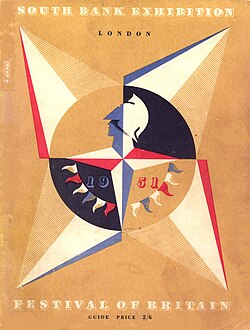
In 1951, The Festival of Britain – a national exhibition – was held throughout the UK to help give the British public a sense of recovery and progress after the devastation of the Second World War, and to promote British science, technology, industrial design, architecture and the arts. It proved immensely popular, with over ten million paid admissions to its six main exhibitions, and helped reshape British arts, crafts and design for a generation. The Festival’s centrepiece was on the South Bank of the Thames which is why now, 75 years later, The Waterloo Festival has chosen to celebrate the anniversary of this marvellous event – and has invited us to join them in a special concert on Saturday 11th July where we will be singing in an engaging, varied programme featuring works by major musical figures of the day.
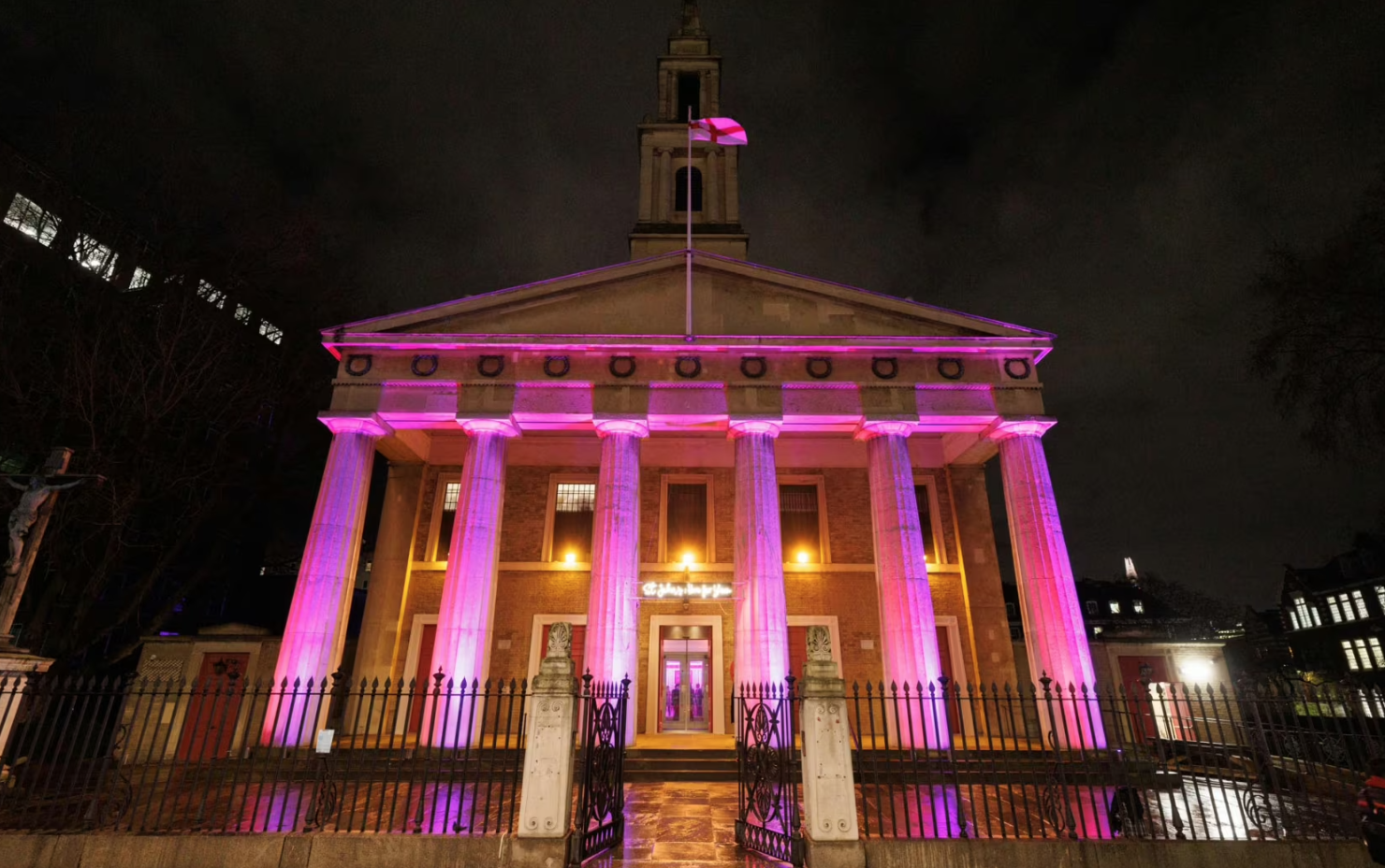
The beautiful surroundings of St John’s Waterloo, a striking Anglican Greek Revival church built between 1822 and 1824 which hosted choral services as part of the 1951 Festival, provide an ideal setting for this sumptuous feast of some of the finest British music of the inter-war and post-WWII period. This concert also offers a rare opportunity to hear us singing a-cappella, showcasing the richness and versatility of our sound beyond our more familiar orchestral performances. Choral masterpieces, sacred and secular, by Vaughan Williams, Finzi, Britten, Imogen Holst and Dyson are interspersed with character pieces for piano, and there will also be a short performance by trumpeter Lucas Houldcroft, an LPO Foyle Future Firsts artist last season.
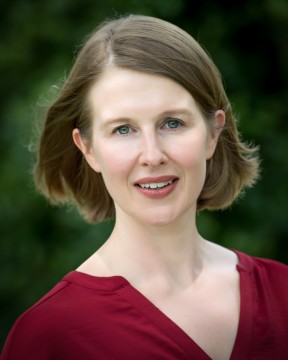 “In selecting works for this concert,” our Musical Director Madeliene Venner told us, “I wanted us to give a flavour of the musical culture in Britain post-war through a varied collection of pieces by major figures of the period, some of whom were commissioned for the Festival of Britain. While the compositions themselves do not necessarily date from 1951, they were all written by artists who fought to maintain the musical threads of Britain through the devastating early decades of the century, not just in their work but in their contributions to the wider community.”
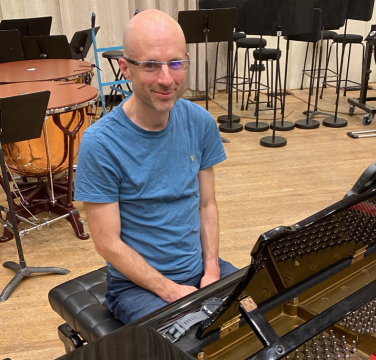
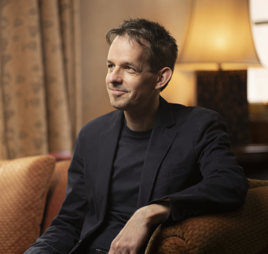
The pianists for this very special concert are two of our fabulous LPC accompanists: Johnny Beatty, our current rehearsal pianist who featured in our November blog, and Iain Farrington who preceded him. Iain is not only a marvellous pianist but also an organist, composer and arranger who arranges music for all kinds of wonderful concerts and events, the most recent being Sir David Attenborough’s 100th birthday concert at The Royal Albert Hall! They perform brilliantly together and are definitely not to be missed.
 |
 |
Do come along – we’re sure you’ll enjoy it! Tickets can be purchased here.
On the subject of the Royal Albert Hall, we will be performing there in this year’s BBC Proms on the 23rd July alongside the BBC National Chorus and Orchestra of Wales in a programme which promises to “pierce the veil between heaven and earth in a spiritually charged concert that opens in contemplation and ends in the blaze of ascension and transfiguration.”
Voices will be raised in prayer in Lili Boulanger’s haunting Vieille prière bouddhique, intensified in the rapt, intimate intercessions of Szymanowski’s Stabat mater. Unearthly beauty is revealed in Messiaen’s L’Ascension, before a dying man is raised to heaven in Strauss’s Death and Transfiguration.
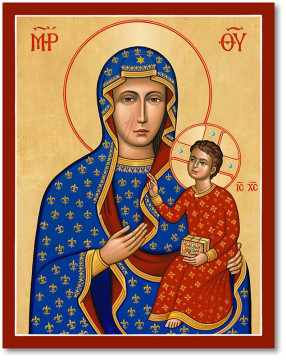 We love singing in a Prom so we were delighted to be asked to take part in this one – even if it meant a day trip to Cardiff for rehearsals! We performed Symanowski’s beautiful Stabat Mater in February with the LPO and Ed Gardner at the Royal Festival Hall, so you can read all about this lovely piece in our blog for that concert here.
Lili Boulanger’s piece is, however, completely new to us so we’re fascinated to learn and sing it. A composer prodigy and pioneer, Boulanger broke barriers and left a lasting mark on the world of classical music. From an early age, she displayed extraordinary talent – so much so that family friend and composer Gabriel Fauré remarked on her natural musical abilities and perfect pitch. She studied piano, violin, cello and harp, though the piano soon became her main instrument. Alongside her older sister Nadia, Lili was encouraged by her parents to explore composition as well, laying the groundwork for a truly groundbreaking career.
At just 19, she made history. After a first attempt in 1912, which was cut short when she collapsed through illness, Lili returned the following year and won the prestigious Prix de Rome for her cantata Faust et Hélène. The prize, one of France’s highest honors for composers, offered recognition, a scholarship, and the opportunity to study at the Villa Medici in Rome. Lili became the first woman ever to win, earning overwhelming support from the judges. Winning the Prix de Rome also earned Lili a residency at the Villa Medici in Rome. There, she focused on composition and developed larger projects, including the beginnings of her opera La Princesse Maleine. Her time in Italy exposed her to new artistic influences and gave her space to refine her voice as a composer, though her stay was cut short by the outbreak of World War I. She continued to compose however and Vieille prière bouddhique comes from this period as she began writing it in Rome in 1914.
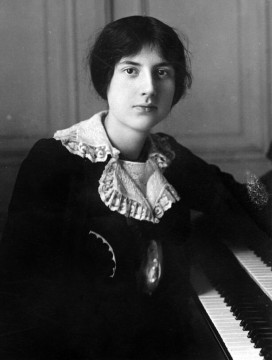
This short spiritual piece sets a French translation of an old Buddhist prayer. Lili Boulanger’s friend Suzanne Karpelès, introduced the composer to the text and was also responsible for the translation from Pali, the Buddhist sacred language. Its subtitle “Prière quotidienne pour tout l’univers” (daily prayer for the whole universe) is an apt introduction to the flavour of the work. The theme of universal fellowship is conveyed through choral writing that is simple, direct and often in octaves, with everyone singing the same line. Modal touches, for instance in the main melody, move the musical language away from something specifically Western classical in style to something less time-and place-bound. The work was premiered on 9th June 1921 at Paris’s Salle Pleyel, conducted by Henri Busser; the performers on this occasion included Lili’s sister Nadia Boulanger at the piano. Tragically, Lili was not there because only a year after she completed this piece in 1917, she died, having struggled with chronic illness throughout her life. She was 24.
Critics and scholars have praised her output for its harmonic language, formal control, and emotional depth; today, her works are increasingly performed and recorded, securing her place among the great composers of her era.
Come and hear us
Saturday 11th July 2026 – 7pm, St. John’s Church, Waterloo
Madeleine Venner conductor
Jonathan Beatty pianist
Iain Farrington pianist
London Philharmonic Choir
George Dyson In Honour of the City
John Ireland piano solos: The Island Spell (Decorations) (Beatty); Ragamuffin (London Pieces) (Farrington); The Scarlet Ceremonies (Decorations) (Farrington)
Gerald Finzi I praise the tender flower; Nightingales; My spirit sang all day (from Seven Poems of Robert Bridges
Benjamin Britten Time; Concord (from Choral Dances from Gloriana)
Imogen Holst A Hymne to Christ
Lennox Berkeley Palm Court Waltz (piano four-hands)
William Walton Popular Song and Foxtrot (from Façade) (piano four-hands)
Ralph Vaughan Williams Valiant-for-Truth; Lord, Thou hast been our refuge
Thursday 23rd July 2026 – 7.30pm, Royal Albert Hall
Ryan Bancroft conductor
Mari Eriksmoen soprano
Paula Murrihy mezzo-soprano
James Way tenor
Szymon Mechliński bass-baritone
BBC National Orchestra of Wales
BBC National Chorus of Wales
London Philharmonic Choir
Lili Boulanger Vieille prière bouddhique
Karol Szymanowski Stabat mater
Olivier Messiaen L’Ascension – four symphonic meditations
Richard Strauss Death and Transfiguration