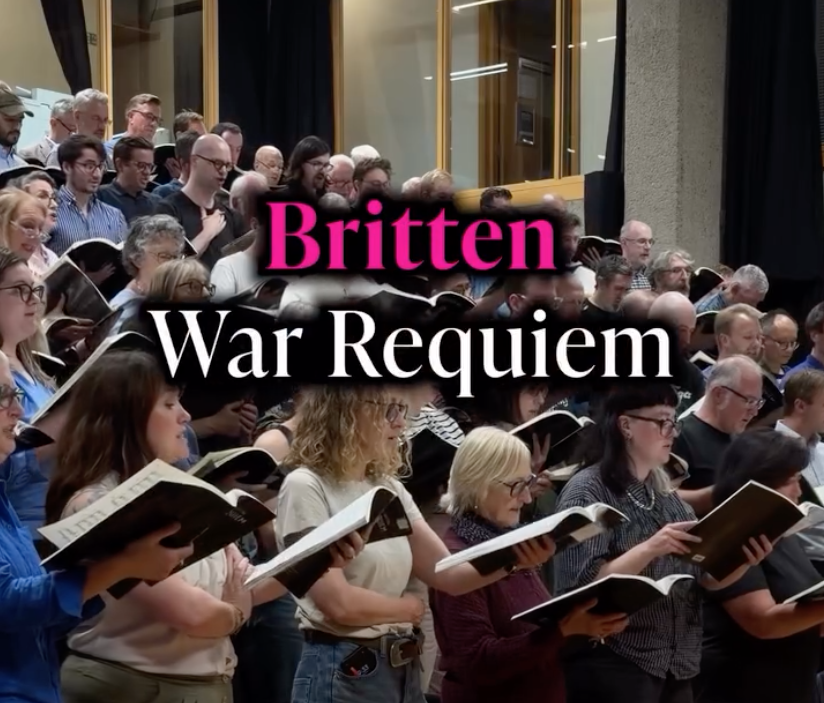
The London Philharmonic Orchestra’s 2026/7 season opens later this month at the Royal Festival Hall with Benjamin Britten’s War Requiem, with the combined forces of us, the London Philharmonic Choir, our friends from the London Symphony Chorus and Tiffin Boys’ and Girls’ Choirs. In this blog, two of the LPC’s sopranos share their thoughts on the upcoming performance – one who has sung the work several times before and one for whom this will be her first performance. Soprano Linda Park got to know the work through performing in it, Chris Banks is experiencing it from the outside in, knowing it well as a piece but only now getting to know it from the inside. Either way, inside out or outside in, Britten’s work has a profound and lasting impact.
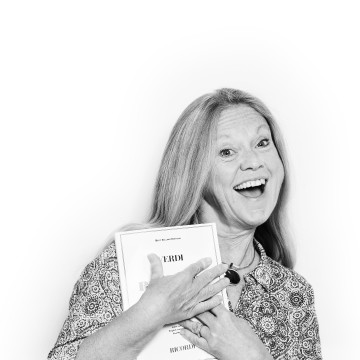 Linda writes: My first encounter with this incredible work was as a young singer, new to London. I knew very little about Benjamin Britten’s work, so this was a completely new soundscape to me and exciting to have the opportunity to sing with a large London choir. The chorus master was Meredith Davies CBE but I didn’t have any idea of his close association with Britten or the War Requiem premiere they jointly conducted. In hindsight I wish I had written down much more of what he said.
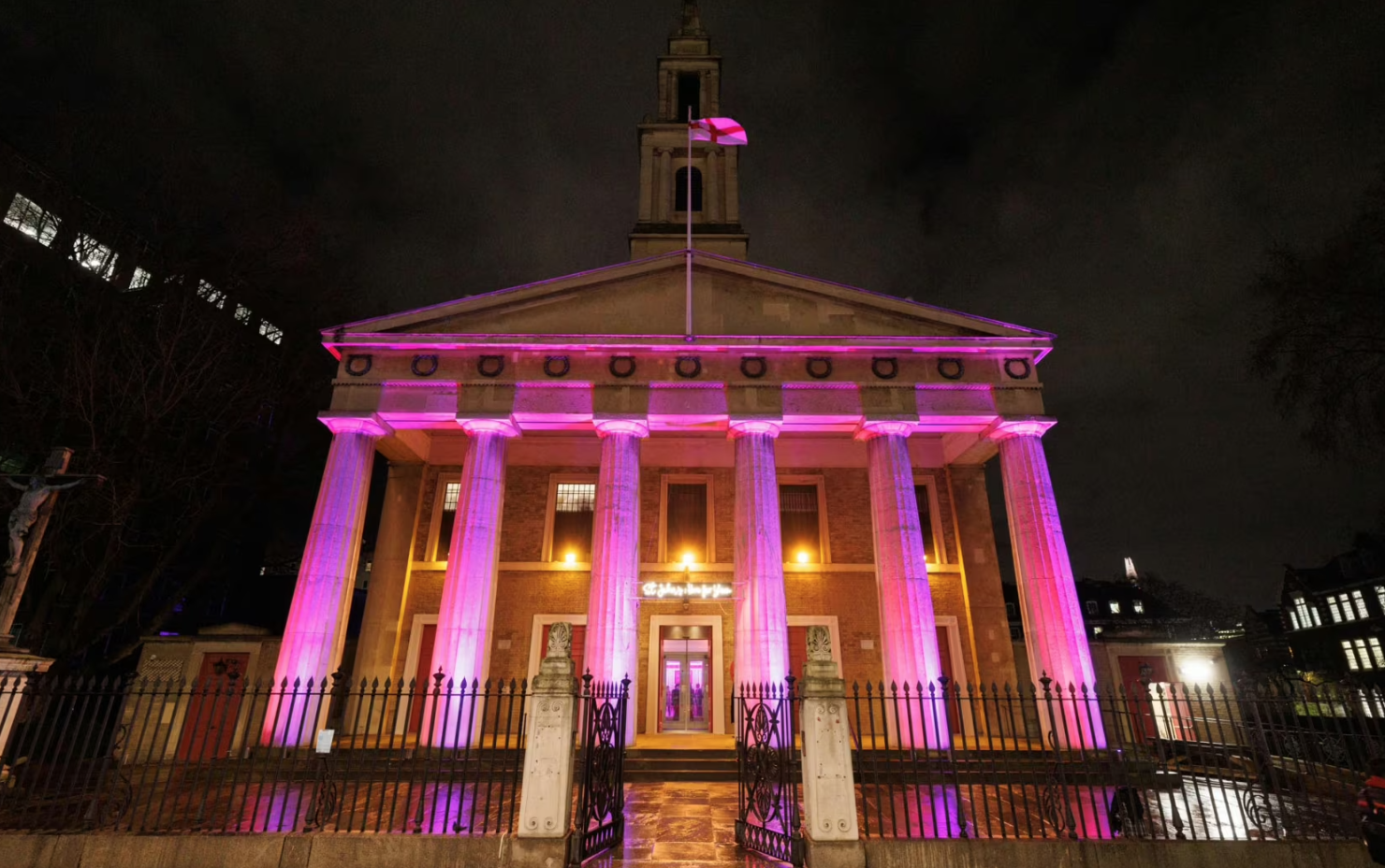
A few years later came another opportunity with a performance near Ypres in Flanders. On 11th November 1988, the 70th anniversary of the signing of the WW1 Armistice, a live performance of the Requiem was to be broadcast on Belgian television. During the free morning some of us visited a Commonwealth war graves cemetery and Ypres Cathedral for an 11 am memorial service. A quick café lunch led to a poignant meeting with a gentleman who was a young boy during the four years of war. As the battlefronts kept expanding his family home was lost to no man’s land and shelling. By the afternoon rehearsal I was approaching this piece with a different mindset. Wilfred Owen’s war poems had more context and the sensitivity of Britten’s setting of them was becoming more apparent. My role within the large chorus of people left behind in mourning also made sense.
I wasn’t the only one affected by the day’s events and the date and place that we were performing. By the time we reached the end of the broadcast performance many choir members were singing with tears in their eyes.
Since then, I have attended moving performances at the Royal Albert Hall and St Paul’s Cathedral and been lucky enough to sing it on a few more occasions, most recently with Vladimir Jurowski at the helm and Neville Creed conducting the chamber orchestra.
Over the years this piece has become more personal as I found out more about my grandfather’s time with the Gloucestershire Regiment in France in 1917. He never talked about the bad times but would always speak fondly of Canadian comrades he was alongside at a place called Vimy. Visiting the Vimy Memorial Park in northern France did make me think about what he really went through. I knew opposing trench lines were never far apart, but when you stand in the gap between them you appreciate just how close.
The Vimy Memorial overlooks the Douai Plain from the highest point of Vimy Ridge. From there you can see for miles and appreciate the importance and scale of the offensive needed for Allied forces to recapture Vimy Ridge. But you can also appreciate the losses on all sides.
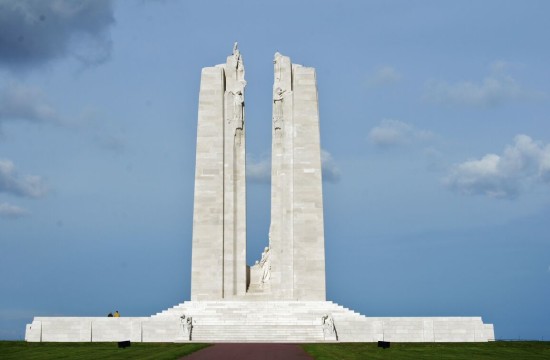
The two towers of the very large Vimy Memorial carry figures representing Justice and Peace and a lone figure standing in mourning for the lost generation of a nation. These same concepts would have been important to Benjamin Britten as a pacifist. The warning message he sent in the creation of the Requiem, incorporating the words of Wilfred Owen, is as important today as at its 1962 premiere.
 For Chris, this will be her first time performing in a work that she has known for over 45 years. She writes: I first got to know Britten’s War Requiem when I was a student back in the late 1970s and it has been on my singing “bucket list” ever since. In my early days as a choral singer I sang with small chamber choirs, two or three to a part, and as such there were certain pieces in the choral repertoire that I’d simply never had the opportunity to perform: Mahler’s Eighth Symphony, Berlioz’s Grande Messe des Morts, Verdi’s Requiem and Britten’s War Requiem to name but a few. In one of those chamber choirs there were some singers who also sang with the LPC and their encouragement along with the fact that the LPC were scheduled to perform both Mahler’s Eighth Symphony and Berlioz’s Grande Messe in the upcoming 2006/7 season gave me the courage to audition. But only now, some 20 years later, has the opportunity to sing the Britten materialised. Indeed, I hadn’t even heard a live performance until earlier this year having never been in the right place at the right time. Nonetheless it is a work that I feel I know intimately, and on each listening, I feel I get more deeply drawn into its profound message of “the pity of war”. But I know it intimately from another perspective, as for some years, between us, my husband and I were the custodians of Britten’s manuscripts, including the various scores of the War Requiem, with me in my curatorial roles at the British Library and him as Librarian at the Britten-Pears Library in Aldeburgh. It was in Aldeburgh that we met Galina Vishnevskaya who was to have sung in the first performance in Coventry Cathedral when she and her husband, Rostropovich, were visiting for the Festival.
Musically, the work is one of extremes. At one end, Britten gives us the immense horrors of the battlefield and at the other, the intimacy of individuals caught up in the utter futility of war. Now that we’ve started rehearsing, I’m struck by how helpful Britten’s score and writing are despite its sometimes complex tonality. Britten never leaves his singers to pluck notes out of thin air. His markings for the choir are incredibly detailed and precise and our job as singers is to deliver what he asks of us. If only those with global influence and power could deliver what he implicitly asks of them.
Come and hear us
Saturday 26th September 2026 – 7pm, Royal Festival Hall
Edward Gardner conductor
Natalya Romaniw soprano
Allan Clayton tenor
Benjamin Appl baritone
London Philharmonic Orchestra
London Philharmonic Choir
London Symphony Chorus
Tiffin Boys’ Choir and Girls’ Choir
Britten War Requiem (available on the LPO Label)